Whining John.

Late last year a friend of mine who works in the media said to me that the press had turned on John Key over the Teapot Tape affair. Key’s attempt to have the photographer prosecuted, following on his defamatory and/or contemptuous treatment of individual members of the press corps, was seen as the last straw. My friend noted that the press had generally been kind to Mr. Key during his first term and had avoided digging into a veritable trove of scandal and mischief simply because Mr. Key was riding high in the polls and they did not want to get off-side of a popular PM. That, my friend said, changed after the election, and the press would take a more critical stance with regard to Mr. Key and his government.

To my mind that was welcome news, because it seemed to me that Mr. Key had been treated with kid gloves during his first term and I felt that he needed to be pushed a bit on matters of National policy as well the behavior of some of his party entourage.

In the first quarter of 2012 a number of questions have been raised to Mr. Key that appear to support my friend’s prediction. None of these questions are particularly damaging by themselves, but a pattern has emerged in Mr. Key’s responses. Slowly but surely, as each new mini-scandal or crisis was revealed, Mr. Key began to drop his smile and wave optimism and replaced it with a surly, if not seething disdain for his questioners. Although he keeps his nice persona sharp for staged interviews on TV and radio, his guard drops when doing the impromptu stand-up Q&A with the press gallery. This was very evident when he was asked on one such occasion about the No Asset Sales hikoi, where he clearly struggled to reign in his contempt before saying that he did not concern himself with the opinion of 1000 people.

Now it appears he has had enough with the press in general and the NZH (and to a lesser extent the SST) in particular. He complained  to a rightwing talkback microphone jockey that the press was aggressive and sensationalistic and singled out the NZH as scandal-mongering in its treatment of him and his government in order to raise flagging sales of newsprint.

I do  not have any particular affection for the NZH, SST or the NZ MSM in general–in fact, just yesterday the TVNZ evening news borrowed without attribution a phrase I had used in a discussion about drones with Chris Laidlaw the day before(a phrase I did not coin or copyright but which I nevertheless introduced to the NZ discussion of the subject, which just happened to be the subject of the news item in the TVNZ One broadcast). Since such behavior is increasingly the norm in the NZ MSM, the standard of NZ journalistic training and ethics is, in my opinion, in the main less than optimal (needless to say there are some exceptions to the rule). But I find it ludicrous that Mr. Key is upset about the “aggressive” and “antagonistic” nature of the press approach towards him as of late. Shoot, he got the press equivalent of a free pass for the first three years in spite of often equivocal, deceptive or disingenuous answers to anything other than patsy questions. Why should he get upset when the questions begin to develop a harder edge? Does he not think such questioning comes with the job? Does he think that he is entitled to be treated differently than other politicians?

Of course, all politicians complain about their treatment in the media and past NZ prime ministers have not been above attacking the messenger or interrogator. But it seems to me that Mr. Key is being very rich when he complains about his recent treatment in the press. It may not be the solicitous if not supplicant posture of the first term, but the press approach to Mr. Key is also not anywhere close to the hostile negativity and contrariness of press corps in a wide range of democracies (I think of the partisan jousting that goes on in places like Argentina, the Philippines, the US, Spain, Taiwan and Italy, where the relationship between sections of the press corps and government executives is often very strained, if not toxic).

Thus I have come to the conclusion, following on previous posts about Mr. Key’s demeanor and attitude, that he is a pampered whiner with a royal’s sense of entitlement. He simply does not see himself as having to be accountable to a critical press, and as a result complains to the lapdog press that he is being treated unfairly. Not only is his accusation untrue. It is also politically stupid because it now has the media dissecting his complaint in public. If he thought he was going to win sympathy from anything other than his diehard base, he needs to think again.

Whatever calculus he may or may not be employing, I have one thing to say to him: harden up and do your friggin’ job, which includes fronting up to hard questions from time to time. After all, you do not get the big bucks just to smile and wave.

Thought for the day: Bank Economists as media expert commentators.

This may sound mean but having bank economists talk about global macro-and political economics on major NZ news outlets is like having pedophiles talking about childcare. Having them speak authoritatively on the “news” skews public perceptions of economic matters towards the preferred constructs of finance capital. Leaving aside the matter of finance capital’s interest in deregulation of capital flows and currency manipulation, using bank economists may be fine when discussing banking take-overs or interest rates in local markets. But there are many other economic interests at play that deserve mention when it comes to issues of political and macro economy and bank economists are ill-suited for a robust discussion of them. To the contrary, their “expert”opinions masquerading as informed commentary in the news media are often poisonous to the integrity of public debate on economic matters.

Is there not a single non-banker economist in NZ who could be used instead? Are all the Economics, Business and Management departments in local universities full of useless PBRF worshippers devoid of real world experience? Are there no economists in research centers, institutes or government agencies who could present a dispassionate and non-vested perspective on the state of global economic play? I find it hard to believe that is the case.

Just saying…

“What a great day for humanity” would probably have done the trick

Today the President of the United States of America came out (if that’s the right term) in support of gay marriage. Hours later, The leader of the New Zealand Labour party did likewise. The responses they got could hardly have been more different. Obama’s statement was greeted with a worldwide ripple of excitement; Shearer’s with a localised wave of criticism. Aside from the obvious difference in scale, we can make some sense of the difference in valence by looking at two main factors: the content of their respective messages in political context; and the media and moment in which they were made.

Substance and political context

Allowing for the differences in political context, Obama’s and Shearer’s statements were reasonably similar. Both expressed support for gay marriage in principle, with reservations about implementation. In Obama’s case, the reservations were constitutional. The President can’t unilaterally pass an act permitting gay marriage; it has to go through two federal houses and most aspects of marriage are still, ultimately, determined by the states. Obama’s statement was symbolic and aspirational. First of all, it was a means of defining who he is, politically — a rebuttal of suggestions that he is timid or not liberal enough, and a means of illustrating a sharp distinction between his administration and the caricatured culture-war conservatism of his Republican opponents. It was also an opportunity to reinvigorate the American political left. David Frum said it well:

The statement changes everything because it galvanizes flagging liberal enthusiasm for this president—while subtly corroding even further the Republican hold on the next generation of voters.

(You should read Frum’s whole piece, it’s short and articulates clearly why this was a strategic coup.)

Shearer’s statement was, if anything, less equivocal than Obama’s; he merely said that he “would like to see the detail of any legislation before giving formal support”. In purely rational terms, that’s totally reasonable; nobody signs a blank political cheque. Much of the criticism has centred on the assumption that any such law would be introduced by Labour, so Shearer would not only get to see it but would get to vet it before declaring support. This isn’t really so; Labour are in opposition, and barring extreme exigencies they will be for at least 2.5 years to come. Given the Greens’ long-standing commitment to gay marriage and remarkable success in the member’s ballot, there’s a better-than-even chance that a hypothetical same-sex marriage bill drawn at random would be theirs.* There are plenty of potential pitfalls in such a bill, if badly drafted, and it is reasonable to hold reservations.

Other criticism of Shearer has centred on the argument that Obama’s political context is much more hostile to gay marriage, and his declaring in favour of it constitutes a genuine act of political bravery, while it’s a rather less contentious issue here. Also not entirely fair; of course, that difference in political context exists, but Obama is in power, and (largely due to Republican infighting) in political ascendancy, while Shearer is in opposition and in the doldrums. It is also very unlikely that any gay marriage bill would pass the current NZ Parliament, especially now that social-conservatives like NZ First are back in.

So on the merits, criticism of Shearer for appending this seemingly-innocuous qualifier seems a bit unfair. But there are two better explanations for hostility: first, he misread his medium; and more importantly, he misread the moment.

The medium and the moment

Obama made his statement in a medium and situation that afforded him considerable control over how his message would be transmitted and received, and that enabled him to articulate his position both from a personal perspective and politically. Good Morning America was a sympathetic venue; morning TV is warm and nonconfrontational, on the ABC network even more so than usual. It is not strictly time-controlled and interviewers generally do not play hardball. Its audience is more liberal, more female, and more inclined to respond favourably to expressions of personal warmth and reflection such as this one.

Shearer chose Twitter to make his announcement — the most constrained medium possible, one that permits no contextualisation, no emotional or personal connection. Given his performance to date as leader of the opposition, and the NZ Twitter left’s activist bias, it’s probably also one of the more hostile media open to him. It’s not talkback, but in some ways it’s worse: a lot of people who really want to like you, but are already frustrated and disappointed and are beginning to despair can be a harsher audience than your outright enemies. Twitter also means that you are expected to be spare and to the point, and to only include detail that is significant. By hedging, he signalled that his position was not firm or genuine. The medium is the message, so the inclusion of an obvious redundancy like “need to see the detail” when characters are so limited doesn’t look like understandable prudence, it looks like fuzzy-headed waffly-thinking at best, or political cowardice at worst. David Shearer mistook a platform for slick, aspirational one-liners as the venue for earnest political positioning.

And that leads to the most crucial point of all: Shearer misread the political moment. Obama’s declaration in personal, philosophical terms of his “evolution” from someone who did not support gay marriage to someone who does was a watershed moment, a genuinely epochal event: when the President of the United States of America supports your cause, all of a sudden it looks a lot more like happening. A loud shot was fired in the culture wars; it instantly became global news, and with the news came a wave of liberal euphoria. This was, as Russell Brown noted, the best possible moment to note Labour’s progressive history and rededicate to the goal of marriage equality, but it was not a time for wonkish quibbling about details, or careful delineation of party policy. The moment was one of joy, of celebration, of possibility — of hope and change — and any response had to be congruent with that. Shearer’s wasn’t. The contrast jarred, and made the other, lesser, deficiencies in the message and its presentation more evident.

Substance, context, medium and moment. You can’t really afford to be without any of these, but if you’re trying to catch a wave of public sentiment, you really have to get your moment right.

This is symptomatic of Labour’s ongoing failure to articulate its vision: a lack of mastery of the tools and techniques at their disposal. Shearer’s lack of authenticity and his inability to speak clearly and unequivocally from his own position, that I touched on in my last post on this topic, was depressingly evident in this episode, and it may be that he’s still being tightly managed. A more concerning possibility is that this is the real David Shearer: lacking in virtù, like his predecessor.

But despite everything, I think this was a good experience for Labour — hopefully it has demonstrated to them that sometimes being timid is worse than being silent. If “go hard or go home” is the only lesson they take from today, it will have been worth it.

L

* Hypothetical, because none are in the ballot at present, though I expect that to change soon. Idiot/Savant drafted one some years ago, and it would not be an hour’s work to get it in.

The GC: is this what we’ve come to admire?

After some consideration of my sanity, I watched the first episode of The GC. It was more or less as I expected. I’ll probably never watch another minute of it, but it’s not a show for me. Nor is it a show for all those other high- and middlebrow honkeys (including Mike Hosking, TV reviewers, and 10,000 Facebookers) who are wringing hands and clutching pearls about how it’s empty trash that glorifies superficial extravagance and shallow excess at the expense of what is “real” or “authentic”, how it’s exploitative and demeaning to Māori, or whatever.

There’s some merit in these critiques, and in the complaints about NZ On Air funding, which it seems to have been allocated to a slightly different show than what ended up actually getting made. But ultimately I don’t think it matters. The GC tells us important things, not only about the beaches, bods and booze society it portrays, but the society from which its participants originated. The most legitimate object of critique is not the show, or its cast, but the system that makes such a bizarre phenomenon not only viable, but compelling.

Always bound to be something. Don’t matter if it’s good or not. Mama always said, “finish your kai. Don’t be fussy!”

Tame (pronounced “Tommy”) was talking about aunties, but the statement expresses the main reason many young Māori leave school and go to The GC and places like it in the first place: because they’re places where there always is bound to be something that’s better than nothing; you take your opportunities as they come up, and eventually you’ll be ka pai. Aotearoa, for many young Māori, is not such a place: the release of employment data showing that Māori unemployment is twice the national average will be no news to anyone who’s been paying attention, and the trans-Tasman wage disparity for those who are employed remains broad. If a kid like Tame can roll like a wideboy property investor on a scaffolder’s coin in The GC, and the counterfactual is minimum wage, gangs and prison back home in Timberlea, why not? As Annabelle Lee-Harris, a producer for Māori Television’s Native Affairs, said on Twitter:

Stay in NZ with the other 83 k unemployed youth or go to the GC where everyone has $ and lives in bikinis? Seems like a no brainer #TheGC … You can’t deny Maori have a far better quality of life on #TheGC. It may seem shallow but actually their kids aint gonna get glue ear etc.

Returning to the question: is this what we, as a society, have come to admire? The answer is yes; this is the neoliberal reality in which we all live. The truth is we always did admire it; it’s only the nouveau-riche cosmetics we cringe at. When our hereditary nobles and “real” celebrities live their extravagant, idiotic lives in public we celebrate them. When a bunch of brown kids do it, all of a sudden they’re an embarrassment; they’re abandoning their heritage, dishonouring their ancestors, should get real jobs and get back in their place.

But it’s all very well for snooty middle-class (and, I suspect, largely middle-aged) white folks to peer down their noses and mutter about how much of a shame it is. It’s easy to do when you’ve got options, mobility and capital (both financial and social). It’s easy to do when you’re not forced to choose between keeping your ahi kā burning, staying with your people and trying to preserve (or find) your place in society on the one hand, and earning a decent wage and staying out of prison on the other. It’s all very well to mythologise and romanticise Māori as a noble people, beyond wealth, if you don’t have to live their reality. And the Māori reality is not static. NZ On Air funding was sought and granted to examine aspects of the contemporary Māori reality. If you look beyond the caricature, the phenomenon examined by The GC is an aspect of the contemporary Māori reality. This goes some way to mitigating the criticism. Former TVNZ CEO Rick Ellis was completely serious (if wrong) when he cited Police Ten-7 as a legitimate portrayal of Māori on TV; there are few outside the niche market occupied by Maori Television, and like the shows on that underrated network The GC at least has the benefit of being made by, for and starring Māori. You don’t have to be very cynical to conclude that there’s a racial motive, however unconscious, behind calls for The GC to be cancelled and its funding redirected to saving TVNZ7, which Paul Casserly recently called “Pākehā TV“.

Maybe the “I’ve got mine” flight to material wealth is simply neoliberalism dragging people away from their values and further into its clutches, but at some point it stops mattering. Māori have had enough generations of being told to be patient, to make do, to play nice and they’ll get what’s good for them. Those who do the telling are are far from impartial. How long are Māori supposed to wait for the Pākehā justice system to make things right, to repair the alienation and dysfunction and reverse the discrimination that still affects them? And even when the system does finally deliver, it’s no sure thing: emerging Māori business leaders are mocked as fools when their ventures fail and abused as fat-cat tribal oligarchs when they succeed. As far as Pākehā society is concerned, Māori can do very little right, so the only surprise about the Mozzie phenomenon is that there are still so many young Māori who haven’t given up waiting for the NZ system to work, and set about making the Australian one work for them. We expect them to act in their own self-interest, and we construct economic and political mechanisms to that end. This is our system, not theirs: if you don’t like their rational responses, don’t blame them: blame yourself, and your part in making it so.

L

Hearing no evil

A few days before the November 26 general election, TV3 aired Bryan Bruce’s documentary Inside Child Poverty, and I posted on the depressingly predictable response of the usual right-wing subjects.

And now NZ On Air board member Stephen McElrea (who, in Tom Frewen’s marvellously dry turn of phrase, “also happens to be John Key’s electorate chairman and the National Party’s northern region deputy chairman”) has used his dual position of authority to demand answers from the funding body and, simultaneously, make implicit but forceful statements about what constitutes “appropriate” policy material for such a funding body to support.

There has been some outrage on the tweets about the obvious propaganda imperative here — agenda-control is pretty crucial to a government, never more so than during election campaigns — and I agree with Sav that this shows a need for NZOA to be more independent, more clearly decoupled from the government, not less so. Stephen McElrea, after all, is not simply a disinterested member of a crown funding agency — he is a Key-government appointee to the NZOA board, a political actor in his own right, and has a history of advocating for broadcasting policies curiously similar to those being enacted by the present government, such as in a 2006 column titled “Scrap the charter and get TVNZ back to business”.

I may write more about this as it develops, although it seems likely that the ground will be better covered by people much more qualified than I am. But what I will do is return to my initial point, to wit:

a documentary about child poverty, covering the appalling housing, health and nutritional outcomes borne by children in our society, and the immediate response is to launch a ideological defence of the National party and deride the work as nothing but partisan propaganda. … I haven’t heard a peep out of National about what they plan to do about the problems since it aired. Isn’t it more telling that National and its proxies immediately and reflexively go on the defensive, rather than acknowledging the problems of child poverty and renewing its commitment to resolving them?

I still haven’t heard that peep. Given the fact that the National party leader feels at liberty to dismiss attempts by David Shearer and others to make child poverty alleviation a matter of bipartisan consensus, and that a senior National party official so close to the leader feels at liberty to throw his weight around in this professional capacity, I rather despair of hearing it.

L

When the media says a woman is no more than a whore

A man moves in with his girlfriend. A few months later, in an argument over the rent, he strangles her to death.

Media coverage:

Nuttidar Vaikaew was killed by her partner, as many women are in our country. She wasn’t killed because she was a prostitute, she was killed because the man she lived with was angry and in his mind extreme physical violence was an acceptable way of reacting to his anger.

If she had been a cleaner, or a lawyer, or a consultant her profession wouldn’t be front and centre in the headlines because it would be her job, not her whole identity. It’s there because of a subtext about women who do sex work: they get themselves killed; they are not girlfriends, wives or mothers; they are no more than whores.

Supporting independent investigative journalism.

There is a fund raiser for Jon Stephenson, the journalist, on Tuesday December 13 in Auckland. Jon is preparing to head back to Afghanistan to continue his work on the conflict and New Zealand’s role in it. He also has some other irons in the fire. In order to do this work he needs funding because the mainstream media outlets are too cheap or too scared of what he may bring back by way of reports. After all, look at how the government responded to his previous stories about NZDF involvement in the Afghan occupation–defamatory personal attacks coupled with a blacklisting from official sources of information even though, as it turns out, pretty much everything he has written has turned out to be true. The hard truth is that governments do not like being exposed and corporate media players do not like being off-side of governments, certainly not when the government is popular and recently re-elected. That means that the NZ MSM shy away from funding Jon’s projects (I could write an entire post on how the SST has handled Jon’s reports in the face of government threats and pressure, but the point about MSM timidity has been made).

Given the sad truth about NZ journalism and the logics that underpin it, a group of interested parties has decided to step in and organize a pub fund raiser for Jon that will allow him to return to Afghanistan. It will include entertainment and a silent auction (I am not involved in the organization of the event so am not completely up on the details). Because journalists of integrity and persistence such as Jon do not come along that often, I am going to break from my Waitakere cover and head into town to attend the event. Should Auckland-based readers be interested in attending, the details are as follows:

Gone by Christmas
6.30pm, Tuesday December 13
The Horse and Trap, 3 Enfield Street, Mt. Eden, Auckland
Tickets: $20 on the door or from Eventfinder.

Friends like these

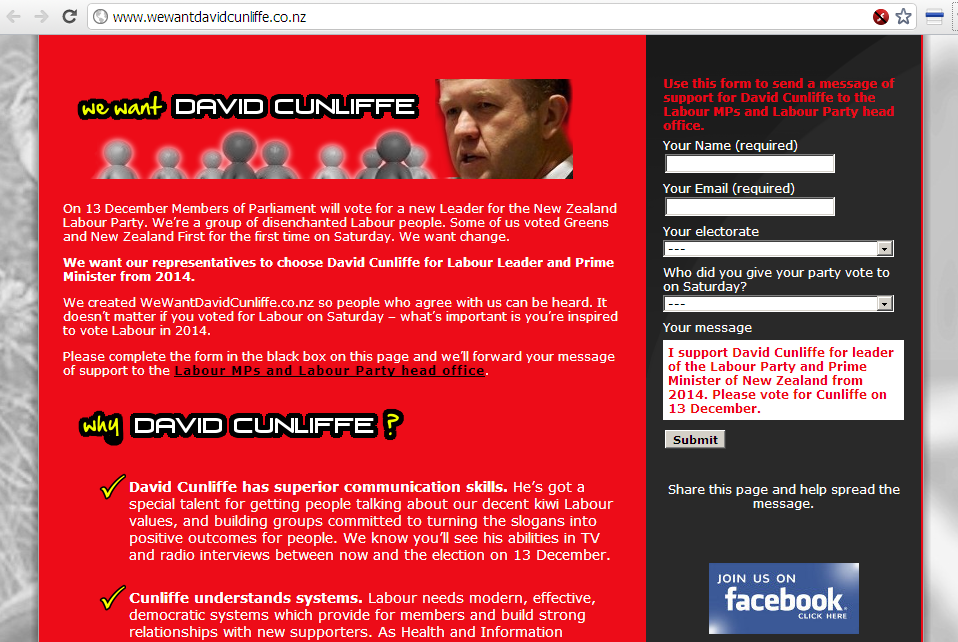
I don’t know who’s set up wewantdavidcunliffe.co.nz to lobby for his leadership of the Labour party, but I’m pretty sure David Cunliffe won’t be thanking them, despite their obvious enthusiasm. Click the image below for a full size version.

wewantdavidcunliffe.co.nz

All the information is broadly accurate (except for the idiotic scaremongering of “Don’t let the right-wing bloggers hijack your party’s Leadership election. Submit the form now!”). Cunliffe is a strong candidate with many good qualities. But I doubt many people will read that far because the site is offensive to the eye. The layout is horrible, and I know colour-blocking is meant to be in right now, but seriously — the dominant red is too much. Contrast with the text is poor, and the faux-script headings and such give the whole thing a 1990s Geocities-Angelfire feel that has no place in the 21st Century interwebs.

Worst of all is the banner — it tells us that grey, faceless bobble-headed people want David Cunliffe as leader. As a friend of mine, a graphic designer by training, said (after “MY EYEEEES”) — aren’t grey bobble-heads the New Zealand First brand?

The use of such symbolism is a slander on David Cunliffe that even a member of Team Shearer like me can’t support.

L

Know your enemy

The image above is “scientifically formulated to enhance [women’s] perception of men who drink Molson […] a perfectly tuned combination of words and images designed by trained professionals. Women who are exposed to it experience a very positive feeling. A feeling which they will later project directly onto [men who drink Molson].”

That’s not my analysis; it’s what the creatives who developed the ad said about it, in another ad. The first ad, the one you see above, ran in Cosmopolitan and was pitched at women. The ad from which the explanatory text was drawn ran in Playboy under the heading “Hundreds of thousands of women. Pre-programmed for your convenience.” The full analysis is here, on the Sociological Images blog.

The lesson is essentially that propaganda relies on market segmentation; messages crafted and pitched with accuracy and intent. If you read what you’re told to read, you’ll think what you’re told to think. Avoiding such a fate means embracing diversity of input, understanding your opponents’ arguments and their reasoning even if you disagree with it. To a large extent that means consuming their media. For a rounded perspective you’ll need, at least occasionally, to read sites like DailyKos and Free Republic, infuriating and interminable comment threads on The Standard and Kiwiblog, and SOLOpassion and Gates of Vienna and WSWS and the Wall Street Journal; listen to talkback, watch Fox News and pick up both Cosmo and Playboy from time to time, for the articles or whatever. This is obviously not an exhaustive list, but the point is: read, listen, watch and discuss promiscuously. Argue with those folks you disagree with; drink beer with them from time to time. Take them seriously. Insist that they take you seriously, and give them reasons to do so.

It might hurt; in fact, it often will. But it beats being a dittohead.

L

Edit to add: Anita points out that the Sociological Images post created a bit of a stir. They write:

Apparently the company has been getting calls from consumers and reporters regarding the Molson Cosmo/Playboy ads we posted about yesterday. It turns out the ad campaign is quite old (2002/2003) and they would like to distance themselves from it now.

As you would. Not clear whether they now regret the decision to run such ads, or whether it’s a pro-forma blowback response.